The screw: a ramp wrapped round a rod
Turn it a long way round, and it moves a short way in, with a lot of force.
How this site works. Every fact is in our own words and linked to its source, beside it. Where good sources disagree, we show each version in a “Sources differ” box.
In terms of how it works, a screw may be thought of as a wedge wrapped around a cylinder. Britannica
Cut a right-angled triangle of paper and wind it round a pencil: the sloping edge becomes a screw thread, an inclined plane wrapped round a cylinder. US Navy
Huge force from a small push
A jack with a 24-inch handle and a ¼-inch thread pitch can, in theory, lift about 15 tons with a 50-pound push. US Navy
Screw jacks lose a lot to friction, on purpose: without it, the weight of the load would spin the jack straight back down. US Navy
Screws around you
Screws are in jar lids, drills, bolts, light bulbs, taps, bottle caps and ball-point pens, and a spiral staircase is a kind of screw. Science Trek
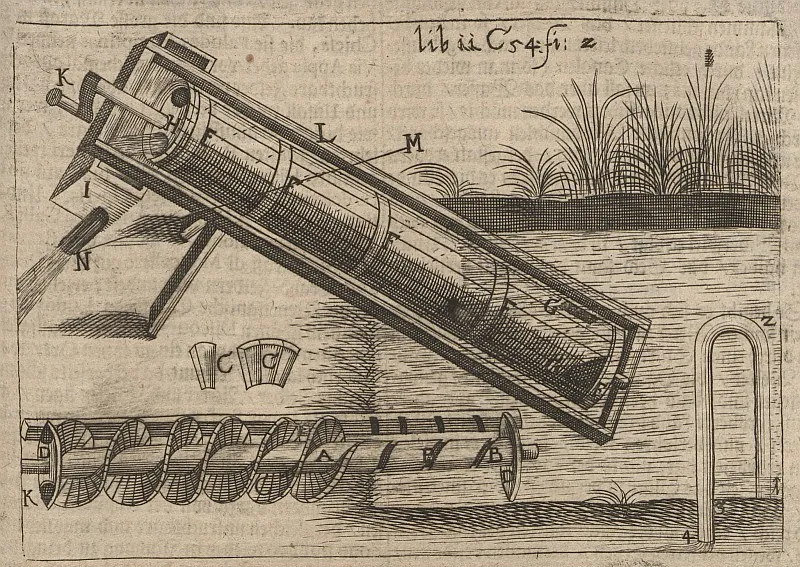
A screw pump turns a big screw shape in water to lift the water up the shaft, often for farms and irrigation. Science Trek
Who invented it? Sources differ
Inventing the screw: sources differ
- Archytas of Tarentum, in the 5th century BC, is the alleged inventor of the screw. Britannica
- The water screw is usually credited to Archimedes, but there is evidence of a similar device in Egypt earlier. Britannica
- The same history traces the screw to Mesopotamia in the first millennium BCE. Ohio Univ.
Nobody knows for sure. The names attached to the screw are traditions, and older devices keep turning up.
The screw press was probably invented in Greece in the 1st or 2nd century BC. Britannica