Levers: give it a long enough handle
A bar, a pivot and a push. The oldest machine trick there is, and probably the one in your hand right now.
How this site works. Every fact is in our own words and linked to its source, beside it. Where good sources disagree, we show each version in a “Sources differ” box.
What a lever is
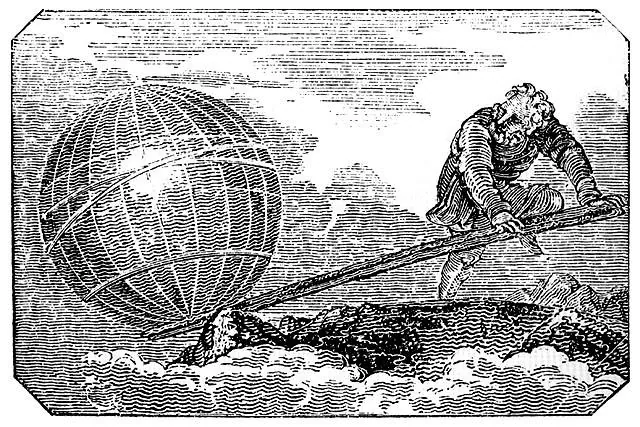
A lever is a bar or board that rests on a support called a fulcrum. Britannica
OpenStax describes it as a rigid bar pivoted at a fixed place called the fulcrum. OpenStax
Every lever has three parts to look for: the effort (your push), the fulcrum (the pivot) and the load. BBC Bitesize
The three classes
What sits in the middle decides the class.
First class: fulcrum in the middle
In a first-class lever the fulcrum is between the effort and the load, as in a seesaw or a crowbar. BBC Bitesize
A pair of scissors is a double first-class lever, with the pivot screw as the fulcrum. Illinois State Univ.
Second class: load in the middle
In a second-class lever the load is between the fulcrum and the effort: wheelbarrows, nutcrackers and some bottle openers. BBC Bitesize
A nutcracker is a double second-class lever. Illinois State Univ.
Third class: effort in the middle
In a third-class lever the effort is between the fulcrum and the load: tweezers, tongs and fishing rods. BBC Bitesize
Your forearm is a third-class lever: the muscle pulls between the elbow and the hand. Illinois State Univ.
A shovel is a lever with a mechanical advantage of less than one: it gives up force to gain speed and distance at the blade. OpenStax
Third-class levers give up force. In return the far end moves further and faster than your hand does, which is just what you want from tweezers or a fishing rod.
The law of the lever
The law of the lever: weights balance at distances from the fulcrum in inverse proportion to their weights. Twice the weight balances at half the distance. Britannica
For any lever, the mechanical advantage equals the effort’s distance from the fulcrum divided by the load’s distance from the fulcrum. OpenStax
The closer the fulcrum is to the object being lifted, the easier it is to lift. Science Trek
Try it with numbers: a load 1 metre from the fulcrum and your hands 4 metres away gives a mechanical advantage of 4, so you push with a quarter of the weight. Your end moves four times as far. (Our arithmetic, from the law above.) You can try your own numbers in the lever calculator.
How much help?
If the crowbar’s long side is five times the short side, your push is multiplied five times. Britannica
A nutcracker is two levers joined at a pin: if the handle is three times as far from the pin as the nut, your squeeze is multiplied three times. Britannica
The longer the handle on a nail puller, the more force you can exert with it. OpenStax
A claw hammer pulling a nail is a lever: a small force on the long handle gives a big pull on the nail. US Navy
In OpenStax’s worked wheelbarrow example, the load sits 7.50 cm from the wheel’s axle and your hands 1.02 m from it. OpenStax The hands are about 13.6 times further from the wheel than the load, so you lift with roughly a fourteenth of the load’s weight (our arithmetic from those two numbers).
Ancient levers
All early people used the lever in some form, for moving heavy stones or as digging sticks. Britannica
A balance beam for weighing, a bar pivoted at its centre, was probably used in Egypt in about 5000 BC, says Britannica. Britannica
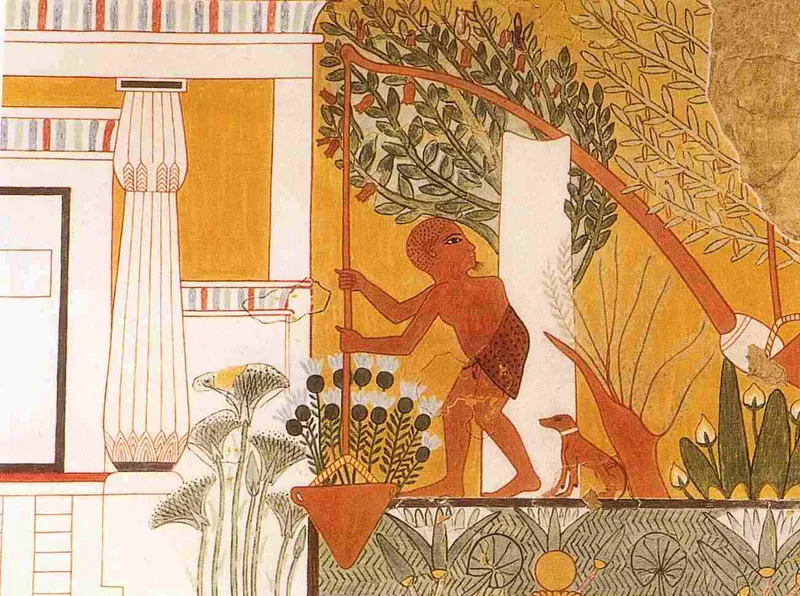
The shadoof is a long lever with a water container on the short arm and counterweights on the long arm; it is said to have been used in Egypt and India as early as 1500 BCE. Britannica With a shadoof, a person could lift several times their own weight by pulling down on the long arm. Britannica
Levers around you
Levers are all around us: door handles, the claws of a hammer, crowbars, light switches, bottle openers and hinges. Science Trek
More on the around the house page.
Our view: the third class is the underrated one. It loses on force every time, and yet your own arm is built that way, because speed and reach are often worth more than strength.
Next: the wheel and axle →