Archimedes and the place to stand
The most famous line about levers, and the trouble with it.
How this site works. Every fact is in our own words and linked to its source, beside it. Where good sources disagree, we show each version in a “Sources differ” box.
Archimedes was born in about 287 BCE in Syracuse, Sicily, and died there in 212 or 211 BCE. Britannica
Archimedes studied three machines: the lever, the pulley and the screw. Acta Baltica
The law of the lever: weights balance at distances from the fulcrum in inverse proportion to their weights. Twice the weight balances at half the distance. Britannica
The basic law of the lever was probably known to scholars before Archimedes; he gave it a mathematical proof. Britannica
The later writer Pappus mentions a treatise by Archimedes On balances and levers, which is lost. MacTutor
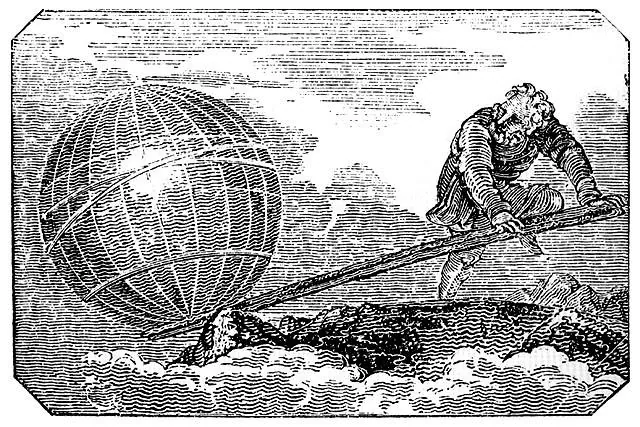
“Give me a place to stand…”
This is the line everyone knows. It is traditional: no writing by Archimedes with these words survives, and the versions we have were written down long after he died.
Did he say it? Sources differ
- Britannica calls the story that he said “Give me a place to stand and I will move the Earth” apocryphal: not reliably recorded. Britannica
- The oldest version is in Plutarch (about AD 45–120), writing some 300 years later: if there were another earth, Archimedes said, by going into it he could move this one. Rorres, NYU
- The famous wording, “Give me a place to stand and with a lever I will move the whole world”, is from John Tzetzes, writing in the 12th century AD. Rorres, NYU
So the idea is old, and fits Archimedes’ work on levers, but the exact words are a later retelling. We give it as “attributed to Archimedes”.
The ship and the pulleys
Plutarch also tells how Archimedes, holding the end of a pulley system in his hand, drew a loaded ship towards him in a straight line. MacTutor
Archimedes is reported to have used compound pulleys to pull a ship onto dry land. Britannica
The water screw
The water screw is usually credited to Archimedes, but there is evidence of a similar device in Egypt earlier. Britannica
See the screw page for who else may have got there first.
Our view: it doesn’t matter much whether he said the line. The idea behind it, that a long enough lever trades a tiny force for an enormous one over an enormous distance, is exactly right.